

What is Ji-Kabuki? How is it Different from Professional Kabuki?
Ji-kabuki refers to kabuki performed by local actors, deeply rooted in regional communities. Moreover, it emerged as kabuki, which originated from “kabuki odori” started by Izumo no Okuni 400 years ago, spread from major cities to rural areas during the Edo period.
Local people who admired professional actors became unsatisfied with merely watching performances and began performing themselves for their own enjoyment—this marked the beginning of ji-kabuki. Furthermore, currently over 200 groups nationwide are engaged in preservation activities, with more than 30 groups concentrated in Gifu Prefecture. Additionally, Nakatsugawa City is home to 6 preservation societies and 3 traditional theater buildings, along with a modern kabuki hall, making it truly the “number one region for ji-kabuki” in Japan.
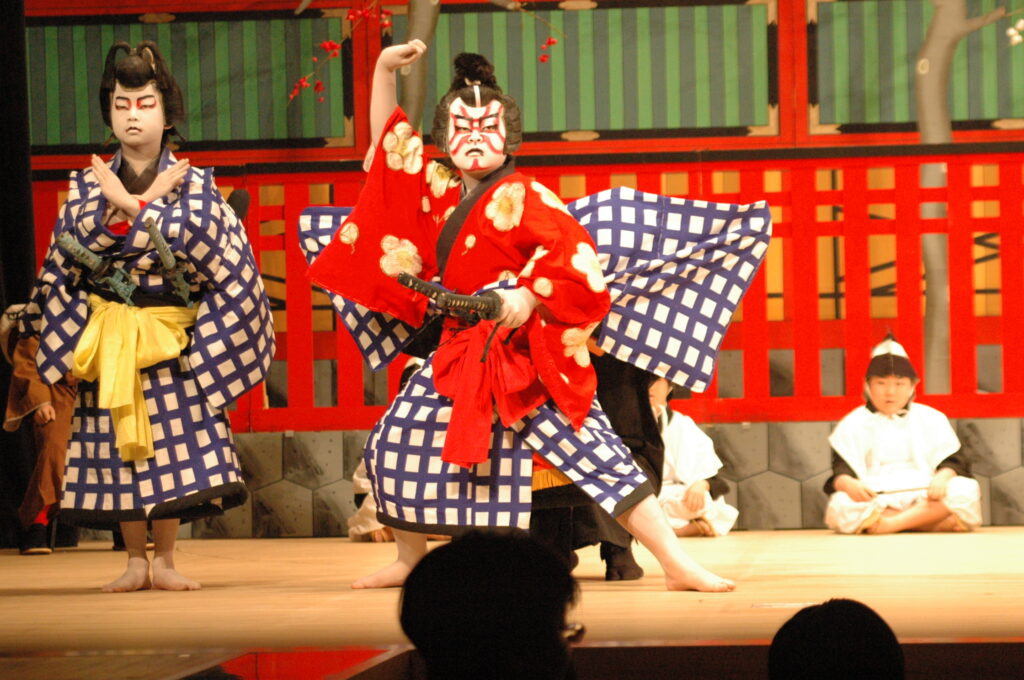
Why Did Ji-Kabuki Flourish in Nakatsugawa?
The reason ji-kabuki became so popular in Nakatsugawa lies in its position as a crucial transportation hub where the Nakasendo and other major highways intersected, facilitating the flow of people, goods, and culture. Moreover, as an important location for the domain due to its high-quality timber production, rural entertainment was officially sanctioned.
Furthermore, the Tono region historically had many independent farmers, and their strong cultural aspirations led them to build their own theaters and perform kabuki themselves. Additionally, the fact that many choreographers and costumes remained during post-war reconstruction became a major factor in preserving ji-kabuki to the present day.

The Thrill of Ji-Kabuki – A World of Excitement Where Audiences Participate
The greatest attraction of ji-kabuki is the enthusiastic atmosphere created jointly by the audience and performers on stage. Moreover, vigorous cheers fly from the audience, and numerous “ohineri” (money wrapped in paper) are thrown onto the stage to enhance the performance.
“Omuko” calls involve shouting “Nippon-ichi!” (Number one in Japan!) the moment actors strike a dramatic pose, adding even more energy to the performance. Furthermore, while general audiences cannot call out during professional performances, active participation is welcomed in ji-kabuki.
“Ohineri” involves throwing small coins wrapped in paper at the actors’ feet—a unique演出 specific to ji-kabuki. Moreover, this spectacle resembles flowers blooming on stage, which is why it’s also called “hana” (flowers), with audiences playing an important role in decorating the stage.

2025 Ji-Kabuki Performance Schedule
Nakatsugawa’s ji-kabuki features various performances scheduled throughout the year:
Regular Performances
- July 13 (Sunday): The 73rd Tono Kabuki Nakatsugawa Preservation Society Kichireiukabuki Festival (Higashimino Fureai Center Kabuki Hall)
- October 26 (Sunday): The 32nd Hida-Mino Kabuki Festival Toki 2025
- November: Tokiwaza Kabuki regular performance, Sakashita Kabuki performance
- December: Tono Kabuki Festival

Special Event! “Hito-Machi Terrace” Ji-Kabuki Mini Performance
This year, special mini performances where you can casually enjoy ji-kabuki will be held at “Hito-Machi Terrace,” within walking distance of our inn:
Performance Dates:
- September 27 (Saturday)
- October 4 (Saturday)
- October 11 (Saturday)
- October 12 (Sunday)
Each day: 8:00 PM start (7:30 PM doors open)
Special Attractions:
- Approximately 1 hour of convenient performance time
- English translation and interpretation available for international tourists
- Local sake tasting while watching (additional fee)
- Photo booth and ji-kabuki exhibition corner
- Photo opportunities with actors
- No reservation required – open to everyone
- Admission: 1,000 yen (includes ohineri)
Performance: Shiranami Gonin Otoko (Aoto Zoshi Hana no Nishikie Inasegawa Seizoroi no Ba)
Experience the Passion of Edo Period Commoners
Ji-kabuki is a precious cultural experience that conveys the unchanged passion and atmosphere of common people from the Edo period to modern times. Moreover, you can enjoy rare repertoires and unique choreography not seen in professional kabuki. Furthermore, participating as an audience member through “omuko” calls and “ohineri” will create special memories unlike any other experience.
Please use our inn as your base to step into the world of Nakatsugawa’s ji-kabuki during this precious opportunity.
Reservations at our inn are easy—just click the link below. ↓